We might still be in the dark about the
Azure-rumped Tanager today, if not for the Mexican naturalist
Miguel Alvarez del Toro. In 1960, Alvarez del Toro led the
first scientific expedition to a remote Chiapan mountain named
EI Triunfo. He was searching for the nearly extinct Horned
Guan, and in Triunfo's cloud forest he finally found it. He
found many other rare and endemic animals there, including
some of Mexico's last Resplendent Quetzals. He had stumbled
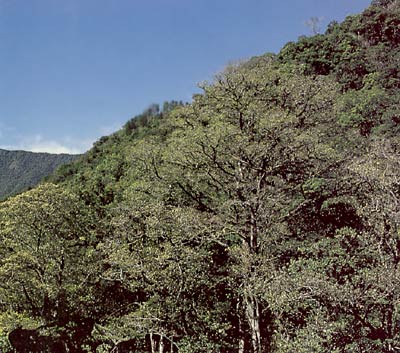
upon a naturalist's paradise, an island of virgin cloud forest
surrounded by sharp belts of pine, subtropical and tropical
dry forest. On his way home from Triunfo, as he crossed a
canyon in the subtropical belt, Alvarez del Toro found one
more rarity- an Azure-rumped Tanager sitting in a tree.
Word of his discoveries spread,
but the inaccessibility of the area made it difficult to explore
further. Nevertheless it soon became clear that one particular
canyon, in fact one particular fig tree (Ficus sp.)
in that canyon, regularly entertained Azure-rumped Tanagers.
Finally in 1982, Bret Whitney, a professional birding guide,
saw a Tanager carrying nesting material into that huge fig
tree. It was the first Azure- rumped Tanager nest ever found,
confirming that the canyon was indeed part of the bird's breeding
grounds. The mystery had been solved.
When Whitney told me he had
found the Tanager breeding ground in El Triunfo, I remembered
all those enigmatic field guide entries and contradictory
paintings, and I saw a chance to resolve the conflicts. I
went to live on the slopes of El Triunfo from January to May
1986, hoping to take the first close-up photographs of the
Tanager.
I
set up camp beneath the "Tanager tree," miles
from the nearest human. The tanager canyon proved to be
a highway for small animals that nightly seemed to enjoy
playing with a camper's nerves. Many nights during my stay
I rushed out of my tent expecting to face a jaguar, only
to find a startled rat or coatimundi in my flashlight beam,
staring at me in astonishment. Eventually I learned to let
the noises of the night. pass unanswered, and I am glad
I didn't read until later Alvarez del Toro's account of
his first Triunfo expedition. Not far from where I slept,
he had found the freshly blood-spattered clothing and possessions
of two men, with jaguar tracks all around.
No such mishap befell me,
and each morning my worries faded into insignificance as
whole flocks of Azure-rumped Tanagers entered the canyon--
sometimes thirty at once! Their activity centered on the
fig tree above my tent; the Tanagers even christened it
with their droppings. To get the best photos I thought I
would have to join them up in that tree, so I rigged the
tree with climbing rope (using a bow and arrow to shoot
a line over the highest branches). But the rope proved unnecessary
as large flocks of Tanagers began landing in a nearby berry
bush, at eye-level in a sunny clearing. It was a photographer's
dream come true. The birds never had close contact with
humans before, so they had no fear and soon allowed me to
work just ten feet away without a blind as they fed.
After four or five days the Tanagers had nearly
stripped the shrub of berries. I found a second bush of
the same species, cut some fruiting branches from it, and
carried them back to the first bush. As I walked with the
fruiting branches in my hand, the Tanagers began watching
me and moved into the trees close by. I quietly sat down
with the berry clusters, and the birds landed in the grass
around me, hungry, expectant, curious, just five feet away.
Their trust touched me deeply. I wished I could have this
kind of relationship with more animals-- but most species
know humans too well by now.
The Azure-rumped Tanager
discovery came none too soon. Because of Alvarez del Toro's
discovery of the Tanager, the Guan and the Quetzal on Triunfo,
and because of his energy and influence, the place is now
officially protected as a biological reserve (managed jointly
by the Mexican government and Alvarez del Toro's Institute
for Natural History). Triunfo's birds are generating international
interest (especially from World Wildlife Fund-Canada) and
tourism (Victor Emanuel Nature Tours and Field Guides, Inc.,
lead tours into this region), and this may slow or even
stop the ongoing destruction of the reserve and its surroundings.
I shudder when I recall the convoluted chain of events that
led Alvarez del Toro to Triunfo. One break in that chain
and the birds could have been left in mystery. The cloud
forest would have been replaced. by yet another sterile
cow pasture or corn field.
Yes, the discovery of the
Azure- rumped Tanager's breeding ground marked the end of
an era for American birding, but it was an era we could
no longer afford. Today's world is not safe for mystery
birds.
Lou Jost
A version of this article first appeared in the April 1989
Birder's World magazine.
|
|