Stig
Dalstrom is a noted orchid expert and artist at Marie Selby
Botanical Gardens in Sarasota, Florida. He illustrates Dr.
Carl Luer's series of Masdevallia and Dracula
volumes, so he knows these plants as only an artist can. Subtle
hard-to-explain impressions about leaf shape, carriage, and
stem color stick in his memory, and since he has painted nearly
all the known species, a strange Masdevallia will capture
his attention even without flowers. He came to visit me in
Baños in 2001, and I took him to the Zone A forests
to search for his favorite plants while I searched for my
favorites, Lepanthes.
His way of moving through the forest was optimized for finding
Masdevallia plants, and it was quite different from
my Lepanthes-optimizing technique. His approach was
slow and deliberate, and his searching style was tactile as
much as visual; a campesino watching him would have thought
he was a blind man fumbling through the forest by touch. He
was not fumbling, but rather searching every likely branch
using his hands to examine the bases of suspicious-looking
orchid leaves. In these forests there are many orchids, such
as Stelis and Pleurothallis, that from a
distance resemble Masdevallia. The leaf bases of
Masdevallia are slightly broader and more succulent,
and the stems are shorter; hence the finger work to inspect
suspicious clumps.
We payed particular attention to fallen giant trees in this
forest. These trees were covered with orchids of many genera,
including some wonderfully odd Stelis and Pleurothallis.
Not far into the day I heard Stig shout out in excitement.
He is a low-key man who does not often shout, so I knew he
had found something good. It was a Masdevallia! It
was without flowers, but something about the leaves (which
looked to me like the leaves of many other Masdevallia
species) and the elevation (too low for the known species
in that group) made him think it was a new species. We found
a few more of the same species that day, and Stig gave me
one to grow so we could confirm his suspicion. I cared for
it as if it were my child, fighting off slugs by night and
aphids by day, and dragging it around with me as I changed
houses from Quito to Baños, where it lived for several
months in my bathroom until I could construct my greenhouse.
Eventually it sent out a flower spike, and it was a thrilling
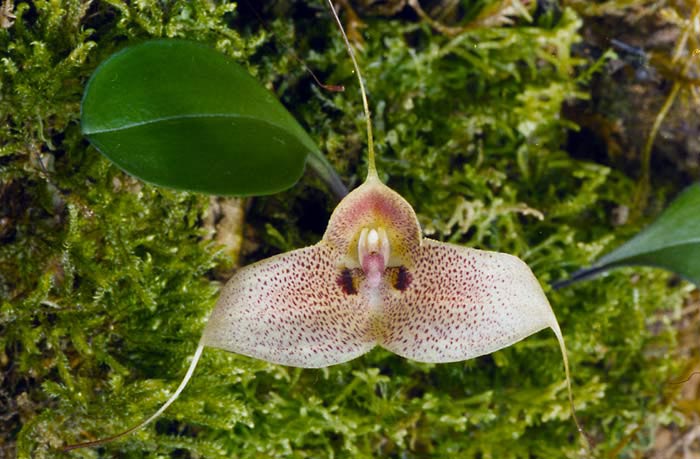
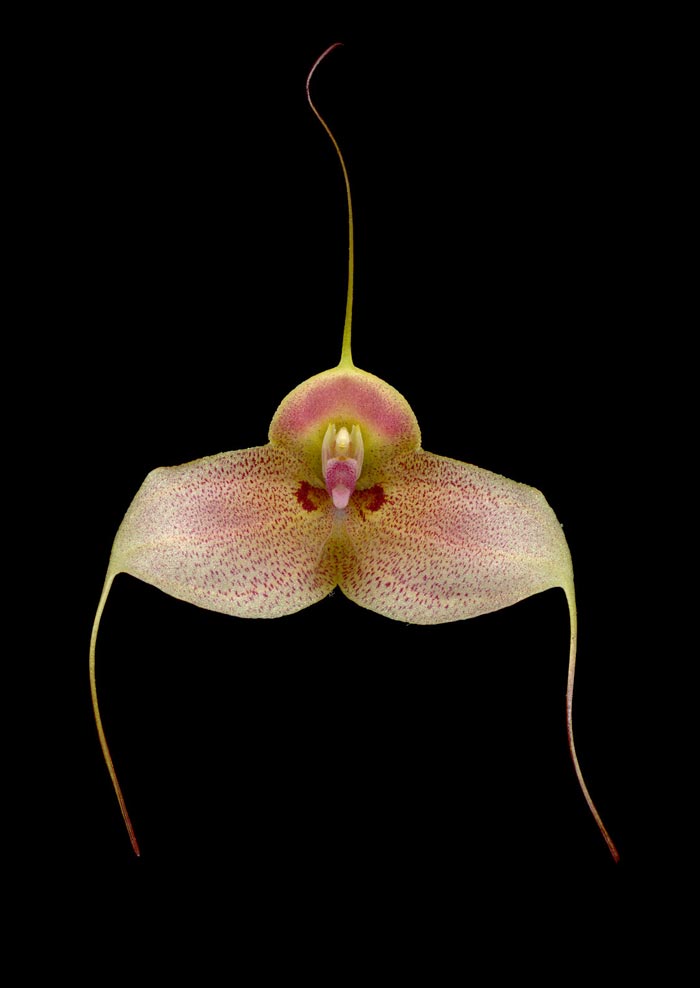
morning when I found the flower open ---and totally unfamiliar.
I sent a scan of it to Stig and Dr. Luer, who realized at
once that it was a new species. There was already a Masdevallia
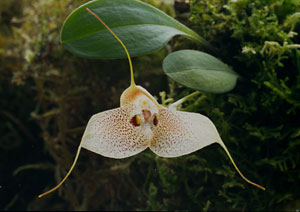
dalstroemii, so Dr Luer would call this one M. stigii.
 |
Since then we have found some additional plants
of this species, but all in the same general area as the original
collection site. It has not been found in any other zone within
the Pastaza Watershed, and it does not occur outside of the
Watershed, as far as we know. The forests where it grows are
valuable for timber and pastureland, and are easy to cut down
because they are almost flat. Deforestation is increasing
in the area, and Masdevallia stigii should be considered
a threatened species.