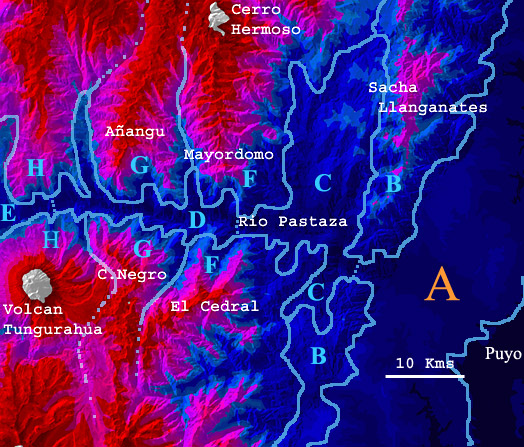
These
are the first significant elevations facing Amazonia, and they
are very wet. The forest is tall and dense, and the trees carry
a very heavy load of epiphytes. The diversity of this tall forest
is high, and there are a very large number of plant species
that appear to be endemic to the zone. Many of the endemic orchid
species were discovered by Joe Brenner, a plant lover who lived
in nearby Puyo. Additional species were discovered by Dr. Calaway
Dodson, who did a study of a 10 sq. km section of this forest
north of Mera. Dr. Dodson found 203 species of orchids in that
forest, an extremely high number relative to other comparable
Ecuadorian sites. I have spent only a small amount of time exploring
this area, alone and with botanists Stig Dalstrom, Tom Croat,
and John Clark. Nevertheless in that short time we discovered
several new orchid species, and even what appears to be a
new genus. See the following pages for photos.
The flora of this zone is closely related to the flora of my
Zone C, the Rio Topo/Rio Negro valleys, which has similar elevations.
It is also related to the flora of other low eastern foothills
facing Amazonia, such as the Cordillera Galeras north of the
Rio Napo. Some of the orchids that were originally thought to
be endemic to Zone A turned up in the Galeras mountains when
I did a survey there.
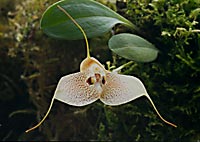 The most spectacular endemic orchids of this zone are undoubtedly
the new Masdevallia species that Stig Dalstrom and
I discovered here over the last two years. Dr Luer is just now
publishing the descriptions of the first two we found, Masdevallia
stigii and Masdevallia loui. I have several other
possibly new Masdevallia species from here in cultivation,
but they have not flowered yet. Other new species from Zone
A include a strange Stellilabium I just discovered,
which mimics a fly butt and is pollinated by a male fly as it
tries to mate with the flower.
The most spectacular endemic orchids of this zone are undoubtedly
the new Masdevallia species that Stig Dalstrom and
I discovered here over the last two years. Dr Luer is just now
publishing the descriptions of the first two we found, Masdevallia
stigii and Masdevallia loui. I have several other
possibly new Masdevallia species from here in cultivation,
but they have not flowered yet. Other new species from Zone
A include a strange Stellilabium I just discovered,
which mimics a fly butt and is pollinated by a male fly as it
tries to mate with the flower.
I hope I will eventually be able to include
pages on all seventeen unique Pastaza Watershed endemic orchids
that are found in Zone A. These orchids grow nowhere else in
the world. Unfortunately these species are very rare and hard
to find, and many have only been found once. At the moment I
have found about half of them. I also include a few orchids
which are almost endemic to this zone; they have very small
ranges special non-orchids which grow in my Zone A and which
have not been found anywhere else in the world, and a few orchids
that are endem. The total number of Upper Pastaza Watershed
strict endemics found in this zone is 68, more than in any other
zone of the Watershed. Unfortunately this zone is almost completely
unprotected, and very vulnerable to deforestation.
Species
illustrated in this chapter:
(
Each opens in its own browser window; close it and you will
be back on this page.)
Plants known only from
the Upper Pastaza Watershed:
New genus
Coryanthes
bergoldii
Epistephium lobulosum
Kefersteinia
lindneri
Kefersteinia minutiflora
Lepanthes
hispidosa
Lepanthes
ruthiana
Lepanthes
"Selby"
Masdevallia
stigii
Masdevallia
loui
Masdevallia mentosa
Maxillaria merana
Monopyle
paniculata (Gesneriad)
Myoxanthus ephelis
Orleanesia ecuadorana
Rare
species known only from this zone and immediately adjacent provinces:
Chondrorhyncha
merana
Lepanthes
ornithocephalus
Porroglossum
condylosepalum
Stellilabium
jostii
Click
here for a table of the Pastaza Watershed endemics known from
Zone A.
To
pick another Pastaza Watershed zone to explore:
Close
this browser window and choose another zone from the contents
page, or press "Forward" below to move to the next
zone.