| Conclusions
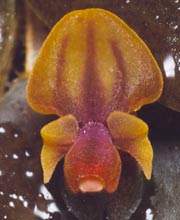
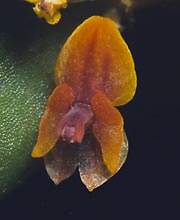
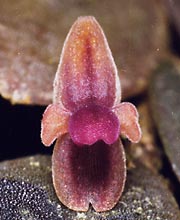
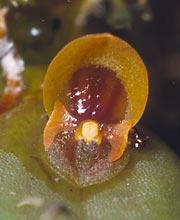
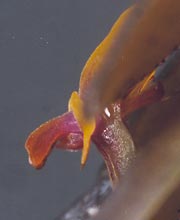
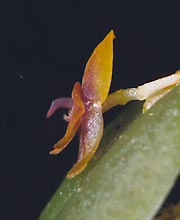
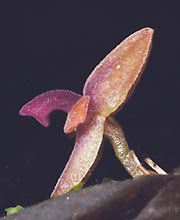
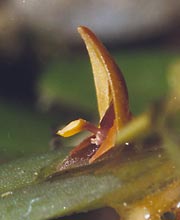
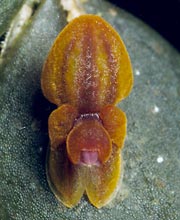
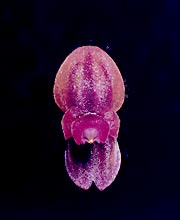
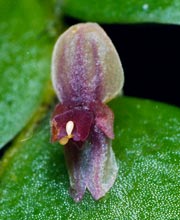
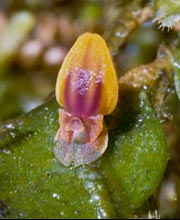
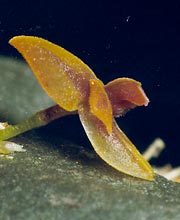
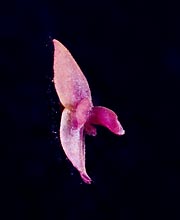
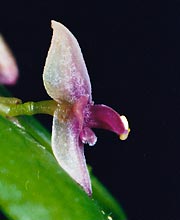
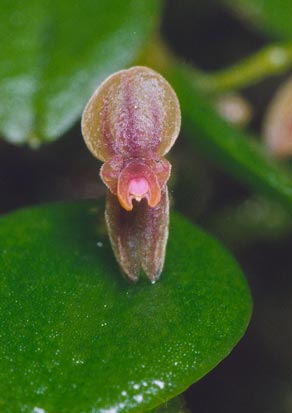
In Tapichalaca in extreme southeastern
Ecuador there are four sympatric forms of Lepanthes
nummularia that are each distinctive. I am sure these
are each different species. I refer to them for now as Forms
A, B, C, and D. These are shown in the photos below: |
|
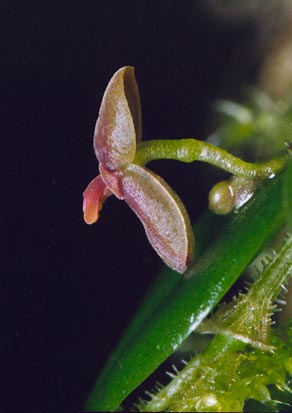
| Lateral views.
Note lip and column differences. All photos
are at the same scale so differences in sizes
are real. |
|
|
| In the eastern Andes north
of Tapichalaca there are three forms of L. nummularia,
shown below. One of these, at far right, is clearly the same
as Form D of Tapichalaca. Another of these, which I call Form
F, at far left, is probably the same as Form A of Tapichalaca.
The two middle photos below show the third form, which I call
Form E, probably the same as Form C of Tapichalaca. It may
be a geographical variation of this Tapichalaca form or it
may be good species. We may need DNA analysis to settle this
question definitively. Dr. Mark Wilson and his students will
investigate this problem. |
|
|
|
|
Form
F, probably same as Form
A of Tapichalaca
in the banos area
|
|
|
|
Form
E from Cerro Abitagua |
|
|
|
|
Another
Form E, from Cordillera
Garcia Moreno |
|
|
|
|
Form
D from Cerro Abitagua |
|
|
|
|
|
|
|
|
|
Form
F, probably same as Form
A of Tapichalaca
in the banos area
|
|
|
|
Form
E from Cerro Abitagua |
|
|
|
|
Another
Form E, from Cordillera
Garcia Moreno in
the banos area |
|
|
|
|
Side
view of this Form
D is not yet available. |
|
|
|
|
|
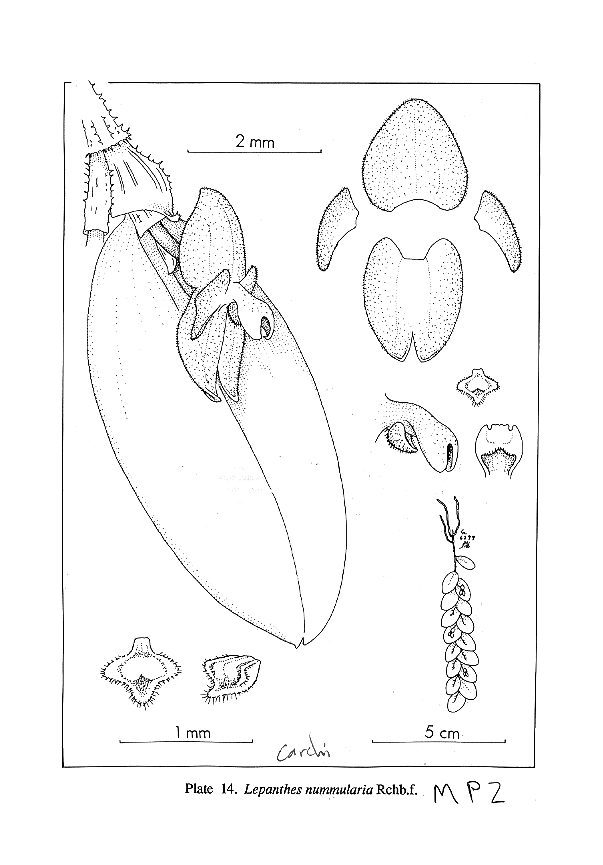
Dr Luer, in his monograph of Lepanthes
subgenus Brachycladium, provides two illustrations of
Lepanthes nummularia. Below is one of the illustrations,
of a specimen collected near La Bonita in northeast Ecuador
(Luer 1994). His other illustration is of a specimen from
northern Colombia. Both are referrable to my Form E (see
photo above), which I have recorded from La Bonita in northeast
Ecuador to the Paute-Mendez Road in southeast Ecuador. It
is the most widespread form. |
|
| This drawing
by Dr. Luer illustrates what I am calling
Form E. |
|
|
| The only modern collections of this species
from the western Andes are of several plants rcently collected
by Lorena Endara. Two of these have flowered in my greenhouse
and belong to a different form, which I shall call Form
G, shown below. It has a distinctive linear appressed lip.
A third plant collected by Lorena in the same area has different
leaves but has not flowered. Since the type specimen of
L. nummularia was collected by Jameson in 1856
in the western Andes near the site of this modern collection,
I suspect that his collection was of Form G or of this unflowered
form. This means that if my different forms are to be split
into separate species, Form G or the unflowered form would
be the true L. nummularia. Morphology suggests
that Form G is distinct from any eastern forms, but we should
await the results of Dr Mark Wilson's DNA analysis in order
to be sure. |
|
|
| Lateral
view of Form G from Los Cedros. |
|
|
|
| In conclusion, the existence of four sympatric
noninterbreeding forms of Lepanthes nummularia at
Tapichalaca in southeast Ecuador proves that there are really
four valid species there, Form A, Form B, Form C, and Form
D. In east central and northeast Ecuador we have three forms,
Form D (the same Form D of Tapichalaca) and Forms E and
F. Form E may be the same as Form C from Tapichalaca; Form
F may be the same as Form A from Tapichalaca. I await DNA
analysis to be sure. Finally, there is at least one form
in western Ecuador, Form G, and this is probably the true
L. nummularia. I propose to split L. nummularia
into between four and six species, depending on how we treat
Form G (this would probably be the true L. nummularia)
and whether we can combine Form E with Form C. DNA
analysis (currently being arranged) will decide the issue.
If I had to guess right now based on morphology, I would
combine A and F, and I would also combine E with C.
I would be uncomfortable doing that, though.
There are two published synonyms of L.
nummularia. One, L. "polygonoides",
was collected by Jameson probably in western Ecuador, and
probably represents Form G again. The other, L. "ospinae",
was collected in northern Colombia and may represent either
Form E or a new form. Old pressed herbarium specimens of
these tiny, fragile flowers are notoriously hard to interpret,
but Dr Carl Luer's nearby collection No. 8871 preserved
in alcohol may shed light on the identity of this form.
Stig Dalstrom has kindly photographed the type specimen
of L. nummularia for me in Vienna, and when these
photos are examined I may be able to tell which is the real
L. nummularia. |
Paute-Mendez
Road (230 km N of Tapichalaca)
Banos
(370 km N of Tapichalaca)
Sumaco-Galeras
National Park (460 km N of Tapichalaca)
La
Bonita, near Colombian border (550 km N of Tapichalaca)
Forms
from Los Cedros, in the western Andes (530 km N of Tapichalaca)
Conclusions
Literature Cited:
Luer, Carlyle. 1994. Icones Pleurothallidinarum
XI: Systematics of Lepanthes Subgenus Brachycladium and Pleurothallis
Subgenus Aenigma, Subgenus Elongatia, Subgenus Kraenzlinella.
Monogr. Syst. Bot. 52. St. Louis, Missouri.
|