| Introduction
A distinctive group
of small pendant chainlike Lepanthes species forms
the subgenus Brachycladium Luer. Members of this subgenus
occur in the Andes mostly at middle elevations (1700-2500
m in eastern Ecuador) in very wet ridgetop forests, where
they are usually rare and local. They are seldom noticed
or collected by nonspecialists because of their inconspicuous
leaves barely larger than the moss in which they grow, but
they are extremely diverse and there are new species discovered
every year. The most common species is L. nummularia
Rchb.f, which occurs from Colombia to Peru.
Dr. Luer (1994) notes that L. nummularia is very
variable: "Some populations with small, elliptical
leaves five millimeters long and three millimeters wide
contrast with others with orbicular leaves 12 millimeters
long and 11 millimeters wide...No two lips from different
collections are exactly the same. The same is true with
the column. In some specimens the column is thick, terete
and more or less clavate. In other collections the column
is more or less flattened and dilated near the middle".
|
|
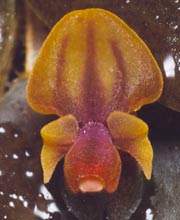
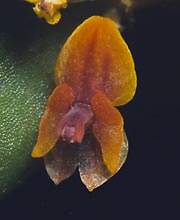
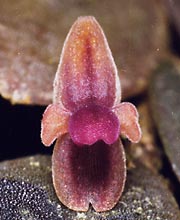
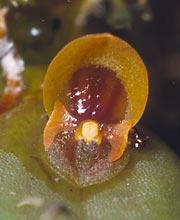
| All
these forms of L. nummularia were
found in a single spot in the Tapichalaca
Reserve of southern Ecuador. One other form,
not in this illustration, was also found
there. |
|
|
| During my studies of the orchid
flora of particular east Andean sites, I have been finding
evidence which strongly suggests that there are several species
currently lumped into L. nummularia. Four of these
are sympatric in the wet forest of the Tapichalaca Reserve,
owned by the Jocotoco Foundation and located between Yangana
and Valladolid in Zamora-Chinchipe Province, Ecuador. It is
this sympatry which proves that they are not simply geographic
races of L. nummularia. In this forest some of the
forms are common enough that I could assess their variability.
I found no evidence of crossbreeding between any of these
forms, even though they all grow intermixed on the same trees.
Therefore I propose to split these Tapichalaca forms into
four different species. Until I have figured out which one
(if any) is the real L. nummularia as described from
Jameson's 1856 collection near Quito, I shall refer to them
as A, B, C, and D. Forms A and B are the common ones. The
photographs that follow illustrate the differences. Note that
these eight photos are all from Tapichalaca, and all were
taken and reproduced at the same scale so that size differences
in the images reflect real differences in flower sizes. |
|
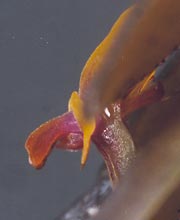
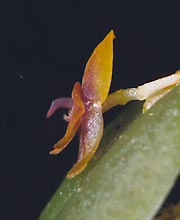
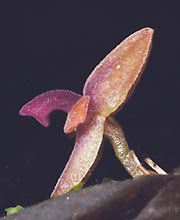
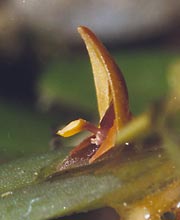
| Lateral views.
Note lip and column differences. All photos
are at the same scale so differences in sizes
are real. |
|
|
| Form A is the big-leaved form mentioned
in Dr. Luer's quotation above. All specimens examined (n =
about 10) are much larger than the plants of the other Tapichalaca
forms, and all have a thick column with a large appressed
lip. Form B has tiny flowers that resemble the flowers of
A but smaller, with much longer lower lobes of the petals
and a much more slender column. The lip curves downward before
curving forward. This is the most common form at Tapichalaca.
Examples vary slightly in the size and shape of the petals,
but show little or no variation in the column or lip. Form
C has tiny petals but a thick column like A. The lip, however,
is microscopic. I found two of these. Form D is much like
Form B but has a thinner column with a disproportionately
long anther, and is the most distinctive of these forms. I
found only one of these in Tapichalaca, but I have seen the
same form in other places. |
Because all these forms grow together
without interbreeding (as evidenced by the lack of intergradation
at Tapichalaca) I think that these are all good species
in spite of their similarities. The problems begin when
I examine collections from outside the Tapichalaca area.
We may safely assume that all four of these species are
geographically variable. Many of the collections from outside
Tapichalaca do not exactly match any of the Tapichalaca
forms, but may still be geographic variations of those forms.
This is where we need the extra clues that DNA analysis
can provide about relationships. Dr. Mark Wilson and his
students will be doing this DNA analysis soon. Meanwhile
we can make some tentative conclusions based in morphology.
|
|
Let's look at the different L. numularia forms
as we move northward from Tapichalaca. These will open in
their own browser windows so you can compare them side by
side:
|
Paute-Mendez
Road (230 km N of Tapichalaca)
Banos
(370 km N of Tapichalaca)
Sumaco-Galeras
National Park (460 km N of Tapichalaca)
La
Bonita, near Colombian border (550 km N of Tapichalaca)
Forms
from Los Cedros, in the western Andes (530 km N of Tapichalaca)
Conclusions
Literature Cited:
Luer, Carl. 1994. Icones Pleurothallidinarum
XI: Systematics of Lepanthes Subgenus Brachycladium and Pleurothallis
Subgenus Aenigma, Subgenus Elongatia, Subgenus Kraenzlinella.
Monogr. Syst. Bot. 52. St. Louis, Missouri.
|